
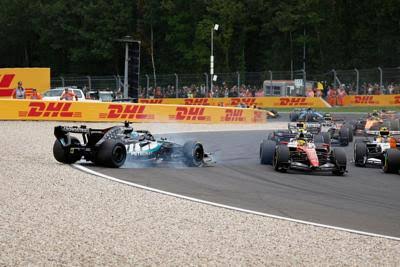


Spa‑Francorchamps produced one of the season’s defining moments when the Belgian Grand Prix turned from a tactical contest into a crisis for Mercedes. Kimi Antonelli converted a finely controlled race into a crucial victory, but the headline moment belonged to the opening‑lap collision that eliminated George Russell and left Lewis Hamilton with a five‑second penalty. That single incident has already reshaped the championship narrative and raised urgent questions about team management inside Toto Wolff’s garage.
The drama unfolded almost immediately. As the field funneled through Eau Rouge and Raidillon, a frantic opening sequence saw Hamilton and Russell wheel‑to‑wheel in close quarters — the kind of high‑risk scenario that marks hundreds of metres of shared history between teammates. Contact on lap one spun Russell into the gravel, instantly ending his race and converting a potential points haul into zero. The stewards judged Hamilton at fault and issued a five‑second time penalty, a relatively light sporting punishment but one with heavy internal consequences.
On paper, a five‑second penalty may seem manageable, but the fallout is strategic and psychological. Russell’s retirement costs Mercedes two points of potential insurance in the constructors’ tally and robs them of the on‑track flexibility that a second car provides when managing tyre strategy and racecraft. More crucially, this is not an isolated mechanical failure or a driver mistake that can be explained away by circumstances — it’s an intra‑team collision. When teammates take each other out, the cost is compounded: championship momentum, team morale, and trust inside the garage all suffer.
For Toto Wolff and his leadership group, the incident deepens an already delicate balancing act. Mercedes’ 2026 campaign has hinged not only on raw pace but on flawless teamwork and split‑second mutual awareness. The Hamilton‑Russell relationship has been a continual subject of scrutiny since Russell’s arrival, with both drivers pushing for victories and, at times, occupying overlapping strategic priorities. Wolff now faces intensified pressure to tighten protocols for opening‑lap behavior, clarify rules of engagement between the drivers, and enforce consequences that deter future collisions without stifling on‑track competitiveness.
Kimi Antonelli’s victory provides a rare silver lining: with Russell out and Hamilton penalised, Antonelli seized the moment to extend his championship advantage. The victory was textbook — clinical starts, smart tyre management, and error‑free execution. He benefited from Mercedes’ internal misstep, but his performance deserved credit. The incident also fuels the narrative that intra‑team problems can directly swing title momentum, making every future head‑to‑head scenario between teammates more fraught.
Beyond Mercedes, the collision influenced competitors’ races and the larger championship map. Max Verstappen delivered a textbook recovery drive to salvage third for Red Bull despite a car set‑up that struggled on Spa’s sweeping sections. Verstappen’s result emphasised opportunity in the chaos: when frontrunners falter, drivers with resilience and a sound strategy can turn damage control into meaningful points. His race underlined how quickly the championship complexion can shift when incidents open windows for rivals.
Looking ahead, Mercedes must confront both the immediate and the structural. Short‑term, team strategists will reassess qualifying and race‑start protocols, possibly imposing radio restrictions or clearer rules for who yields in mixed situations. Medium‑term, the team needs a cultural reset to rebuild trust and ensure both drivers accept unified racecraft principles. For Wolff, these are managerial tests as much as sporting ones — how to preserve internal motivation while preventing future zero‑sum collisions.
Spa’s opening‑lap confrontation is more than a single dramatic highlight reel; it is a turning point. The five‑second penalty for Hamilton and Russell’s non‑finish are statistical lines in the race report, but the real score to settle will play out in team meetings, race weekends to come, and the psychological battle for cooperation versus individual ambition. If Mercedes wants to salvage a smooth title defence, resolving this civil war quickly and transparently is essential — because in Formula 1, internal fractures often cost more than a handful of championship points.