
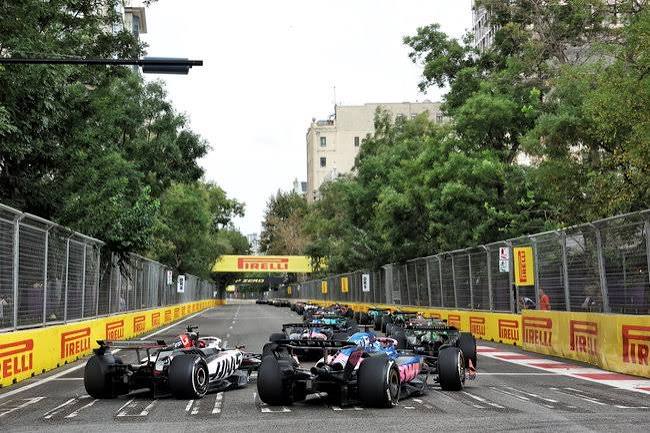


Formula 1 heads straight from Monza’s temple of speed into the even more contradictory confines of Baku, where the 2.2 km main straight and the tight Castle section force teams into one of the season’s toughest aerodynamic compromises. The Azerbaijan Grand Prix setup battle revolves around a simple but punishing trade-off: run minimal drag to maximise top speed down the straight, or carry enough downforce to survive the slow, 90-degree corners and technical Old City without destroying the tyres or locking into the walls.
Baku’s layout magnifies every weakness in a car’s balance. The long flat-out run from the final corner to Turn 1 rewards ultra-low drag, yet that same straight feeds directly into one of the heaviest braking zones on the calendar, where front-end stability and confidence under deceleration are non-negotiable. Teams that trim too aggressively may gain several kilometres per hour on the straight but then struggle to rotate through the Castle section, forcing early throttle application, increasing rear slip and accelerating tyre degradation on the softest compounds.
Pirelli has responded by bringing a harder trio than in recent years—C3 hard, C4 medium and C5 soft—reflecting Baku’s stop-start nature and the need to manage repeated heavy braking and traction events. Despite being a street circuit, the relatively smooth, low-abrasion asphalt usually produces low-to-medium degradation, making a one-stop strategy the default if the safety car does not intervene. The real variable is temperature: as track conditions cool in the late afternoon, tyre warm-up becomes critical, especially for cars running minimal wing and therefore less inherent grip through the slow sectors.
This is where the “Baku set-up chess” becomes most visible. Cars that generate efficient underfloor downforce can afford to run less rear wing, gaining top speed without completely sacrificing traction out of the slow corners. Mercedes, for example, have shown strong low-drag mastery in recent sessions, allowing them to trim aggressively while still rotating through the Castle section without excessive rear instability. McLaren arrive with upgrades but remain wary of Baku as a “circuit of extremes”, where any imbalance between straight-line efficiency and cornering grip is brutally exposed.
Braking stability into Turn 1 is the key performance differentiator. Lock-ups here not only cost lap time but also invite overtakes down the inside, especially with the extended DRS-style “Overtake Mode” zone feeding into the corner. A weak front end, whether from insufficient downforce or poor brake migration settings, forces drivers to brake earlier and more cautiously, surrendering several tenths before the corner even begins. Conversely, a car that can brake late and stable, then get on the throttle early, can defend or attack with minimal risk of running wide into the tire barriers.
Off the back of Monza, all eyes are on Kimi Antonelli and how his momentum translates to Baku’s unique demands. The young Mercedes driver’s stunning win from 19th on the grid in Italy showcased raw pace, tyre management and composure under pressure, but Baku presents a different set of challenges. Here, race-pace setups must balance low-drag efficiency with the ability to keep tyres in the correct temperature window through long cooling phases on the straight and repeated heavy loads in the Old City. For Antonelli and other rising drivers in midfield outfits, Monza’s telemetry revelations about straight-line speed and brake stability must now be adapted to a circuit where a single lock-up can end a race against the concrete walls.
As the grid assembles for a Saturday race under the lights, the teams that solve Baku’s trim vs downforce dilemma while nailing braking stability and tyre temperature management will hold a decisive advantage. In a season where every point counts, the Azerbaijan Grand Prix could reshape both the championship picture and the driver market narrative around who can truly master this circuit of extremes.