
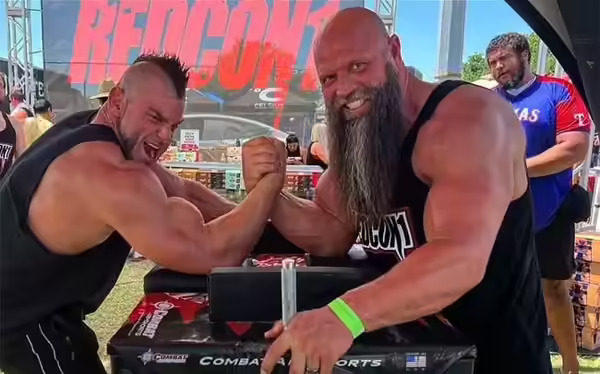


Few athletes in any sport can claim they single-handedly forced their governing bodies to rewrite the rules, but Michael Todd, known across the arm-wrestling world simply as “The Monster,” belongs in that rare company. Hailing from Little Rock, Arkansas, Todd has spent well over two decades at the top of American arm wrestling, amassing national and world titles while becoming one of the sport’s most polarizing and talked-about figures, largely because of a single defensive technique that fans either love or despise with equal intensity.
Standing 6 feet 3 inches and competing in the super heavyweight and heavyweight divisions, typically somewhere between 105 and 115 kilograms, Todd built the first half of his career as an explosive inside puller, someone who thrived on aggressive shoulder pressure and quick, decisive finishes. That approach changed dramatically after a series of fractures to his right arm left him physically unable to bring his elbow close to his body the way the sport’s conventional inside game demands. Rather than retire or fade into irrelevance, Todd adapted, and in doing so created what has become arguably the most controversial technique in modern arm wrestling: the King’s Move.
The King’s Move works by dropping the shoulder and hip low beneath table level while fully extending the arm and locking the pronator, allowing Todd to lean on bone structure and tendon integrity rather than raw bicep strength alone. Years of accumulated microtrauma from hard pulling left him with a genuine inability to fully straighten his elbow, turning what began as an adaptation into something closer to a structural lock, a defensive position that becomes extraordinarily difficult for opponents to break down without risking a foul themselves. The technique proved so disruptive to conventional arm-wrestling strategy that it sparked years of rules debates across major federations, ultimately forcing leagues like the World Armwrestling League (WAL) and East vs West to rewrite their regulations around how low a competitor’s shoulder could legally drop relative to the pad. Few athletes can say they changed the sport’s rulebook simply by being too difficult to beat using a single technique, but Todd managed exactly that.
That technique carried him to the very top of North American arm wrestling during the WAL era, where he captured both the Super Heavyweight and Heavyweight hammer titles, cementing his place as one of the league’s defining champions. His rivalry with Canadian legend Devon Larratt became one of the most closely followed storylines of that period, with their clashes, including a hard-fought victory for Todd at WAL 406 that claimed the right-hand heavyweight title, standing among the most-watched matches of the sport’s modern television era. Their rivalry later continued at King of the Table, keeping the Todd-Larratt dynamic alive well into a new chapter of professional arm wrestling.
Beyond his battles with Larratt, Todd’s career reads as a tour through nearly every major international powerhouse the sport has produced. Over more than two decades, he has shared the table with Russian phenom Denis Cyplenkov, Ukrainian standout Andriy Pushkar, fellow American heavyweight Jerry Cadorette, Italy’s Ermes Gasparini, Georgian puller Genadi Kvikvinia, Norway’s Lars Rørbakken, and Frank Lamparelli, among others. Facing that breadth of international styles across such a long career is itself a mark of longevity few competitors in any combat sport can match.
What makes Todd’s story particularly compelling in recent years is how he responded after enduring rough patches against Europe’s elite super-heavyweight powerhouses. Rather than accepting decline as inevitable, he underwent a significant physical transformation, trimming down into lower weight divisions around the 105 to 115 kilogram range at promotions like East vs West. That shift allowed his speed, transitions, and signature King’s Move to regain much of their original effectiveness, giving him a genuine second wind against competitors many years his junior. For a veteran well into his late forties, reinventing his diet and training approach to remain competitive at the sport’s highest level speaks to a level of discipline that extends well beyond raw talent.
Todd has also become one of arm wrestling’s most recognizable personalities away from the table. Drawing on a powerlifting background and a willingness to engage directly with fans and rivals on social media, he has leaned into psychological gamesmanship and showmanship as much as technique, helping expand the sport’s visibility to audiences who might never have otherwise tuned in. That combination of controversy, technical innovation, and personality has made him a figure impossible to ignore in any serious conversation about the sport’s modern history.
From forcing international federations to rewrite foul guidelines to reinventing himself physically deep into his career, Michael Todd’s legacy in arm wrestling extends far beyond medal counts. He remains proof that adaptability, even when born out of injury and necessity, can become a competitor’s greatest weapon, and that a single, well-executed idea can leave a permanent mark on how an entire sport is played.