
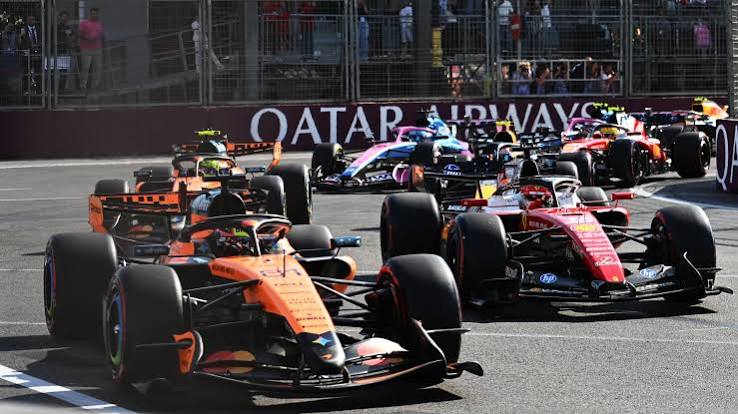


George Russell converted pole position into a dramatic victory at the Azerbaijan Grand Prix, holding off Max Verstappen by just 0.196 seconds in one of the closest finishes of the 2026 Formula 1 season. The Mercedes driver led from start to finish, while teammate Andrea Kimi Antonelli recovered from 16th on the grid to finish fifth.
The result was not simply a triumph of straight-line speed. It was a demonstration of Mercedes’ ability to protect track position, manage the tyres and respond to a race repeatedly reshaped by safety-car interruptions. Verstappen applied pressure late in the race, but Russell remained calm through the restarts and delivered the final laps without making the mistake Red Bull needed.
Baku is a unique test for modern Formula 1 cars. The circuit combines a long full-throttle run from the final corner to Turn 1 with a narrow, technical section around the old city. Teams must find a compromise between low drag for the straights and enough aerodynamic stability to attack the slow corners.
Mercedes appeared to find that balance more effectively. The car was fast enough on the main straight to deny Verstappen an easy overtaking opportunity, while retaining the confidence required through the slower sections. Russell’s early pace allowed him to build a cushion before the interruptions brought the field together.
Red Bull’s car remained formidable in a straight line, but that advantage was not enough to overcome the strategic value of clean air. Verstappen started eighth and made progress through the field, yet the late safety-car periods erased Russell’s advantage and created a direct fight for victory. Even then, Mercedes’ earlier pace had already placed Russell in the strongest possible position.
The final restart became a test of tyre preparation and execution. Russell had to generate enough temperature without overheating the rubber, position his car correctly for the first braking zone and control the race while Verstappen remained within striking distance. A small lock-up or poor exit from the final corner could have changed the result.
Instead, Russell produced a controlled defensive drive. He managed the gap through the technical sector and used the long straight to prevent Verstappen from building a decisive slipstream. The margin at the chequered flag—less than two-tenths of a second—showed how little separated the two cars at the finish.
Antonelli’s fifth-place finish provided another major storyline. The Mercedes rookie had crashed in qualifying and started from the back row, but recovered through a combination of pace, patience and favourable timing during the safety-car periods. He reached the points-paying positions by Lap 18 and continued climbing as rivals encountered trouble.
His result extended an impressive rookie campaign. Antonelli had already recorded consecutive podiums before Baku, and another top-five finish demonstrated that he can recover from setbacks without allowing one difficult session to define his weekend.
The victory also changed the championship picture. Russell reduced Antonelli’s lead to 66 points, with the younger Mercedes driver still at the top of the standings. Mercedes therefore leaves Baku with both the race win and a renewed internal title battle.
The next challenge is the Marina Bay Street Circuit in Singapore. Unlike Baku, Singapore places greater emphasis on cornering grip, traction and car stability over long, slow sequences. Red Bull’s straight-line strengths may be less decisive there, while Mercedes will need to prove that its recent progress extends beyond high-speed layouts.
Baku showed that fine margins can be converted into major results when a team combines aerodynamic efficiency with disciplined strategy. Russell did not need the fastest car in every corner; he needed the best overall package and the cleanest execution. Mercedes delivered both, while Antonelli’s recovery added evidence that the team’s future remains just as competitive as its present.