
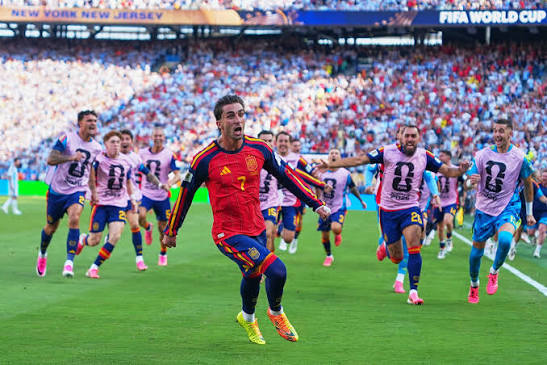


Spain completed a dominant World Cup campaign by defeating defending champions Argentina 1-0 after extra time in a tense final at the New York New Jersey Stadium on July 19, 2026. A single, decisive moment from Ferran Torres in the 106th minute settled a game that had been cagey and intense for much of its duration, and it crowned La Roja as world champions for the second time.
The match unfolded as a tactical chess game between two nations with contrasting styles. Spain, underpinned by youthful energy and precise possession play, controlled the flow for long periods. Argentina relied on experience, defensive resilience, and a low-numbered injection of threat on the break. Statistically, Spain’s control was emphatic: they finished the match with 20 shots to Argentina’s two, and their dominance across the tournament was reflected in a defensive record that now stands at a single goal conceded across eight matches.
The breakthrough arrived early in the extra period. A patient Spanish attack was kept alive by Nico Williams, whose determination to keep the ball in play created the opportunity. Ferran Torres, timing his run to perfection, clipped home the finishing touch past Argentina’s keeper Emi Martínez in the 106th minute. The strike was the product of sustained pressure and sharp movement — a small moment that unpicked Argentina’s stubborn rearguard and delivered the trophy to Spain.
Argentina’s route to the endgame was complicated when Chelsea midfielder Enzo Fernández was sent off late in stoppage time of normal play. Fernández received a second yellow in the 90+3’ minute, reducing the defending champions to ten men and forcing them to navigate the physically and mentally gruelling extra 30 minutes with a numerical disadvantage. Despite the setback, Argentina defended with heart and limited Spain’s clear chances until Torres’ goal.
Lamine Yamal and Rodri were central to Spain’s campaign. Yamal’s creative bursts and incisive runs provided constant problems for opponents, while Rodri’s calm leadership in midfield anchored Spain’s possession-first approach. Across the tournament, Spain blended youth and tactical discipline to suffocate opponents and create openings through patient build-up rather than frantic transitions. Their ability to control tempo and territory was decisive when the stakes were highest.
For Argentina, the final was a harsh end to a run that featured resilience and quality. Their defensive unit and goalkeeper Emi Martínez kept the score level for long stretches, and the team’s tactical adjustments after Fernández’s dismissal showed character. Yet Spain’s relentless passing and high volume of attempts eventually produced the moment that mattered.
This World Cup win has broader significance for Spain. It replicates a rare international double: holding both the European Championship and the World Cup simultaneously, a feat first achieved in 2010. The 2026 title solidifies a golden generation’s budding legacy and highlights the strength of Spain’s development pipeline, which has produced technically gifted, tactically aware players capable of performing on the biggest stage.
In the aftermath, images of jubilant Spanish players embracing on the pitch and fans erupting in celebration painted the emotional payoff of years of planning and investment. The final also reinforced football’s global reach: a tournament decided on American soil, featuring two footballing powerhouses and delivering drama until the final moments.
Spain’s campaign will be studied for its tactical coherence and defensive mastery, but on this night the story is simple: a team that controlled games, limited opponents, and seized the single decisive moment in extra time. Ferran Torres’ goal will be replayed for years to come as the instant that crowned La Roja world champions once again.