
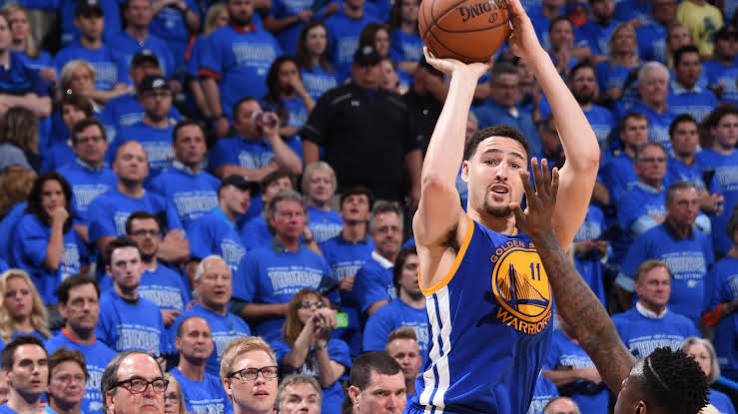


Klay Thompson has never needed to be the loudest voice in a basketball conversation. His shooting, defense and championship résumé have usually done the talking. But when fans recently questioned his place in NBA history, the four-time champion entered the debate himself, using social media to remind critics that his career was built on far more than playing alongside Stephen Curry and Kevin Durant.
The discussion began with a comparison between Thompson and Hall of Fame shooter Ray Allen. One fan argued that Allen was the superior primary option because he led the Milwaukee Bucks to the 2001 Eastern Conference Finals without another All-Star. The implication was that Allen carried a larger individual burden, while Thompson benefited from playing beside Curry and, later, Durant.
Thompson’s response was direct. He pointed out that he was the second-leading scorer on two Golden State championship teams that did not include Durant—the 2015 and 2022 Warriors—and suggested that leaving a strong team to become the leading scorer on a weaker roster would have allowed him to accumulate what he called “empty stats.” His broader argument was clear: individual numbers are valuable, but postseason success should not be dismissed simply because a player shared the court with other elite talent.
That distinction sits at the heart of Thompson’s legacy. He was never asked to dominate the ball like Allen did in Milwaukee or Seattle. Instead, his value came from the way his presence changed the geometry of the court. Defenses could not leave him open, even when he was not handling the ball, and his ability to defend elite perimeter players allowed Golden State to build lineups around movement, spacing and pressure.
The strongest evidence for Thompson’s ability to shoulder a greater offensive load came during the 2016 playoffs. After Curry dealt with injuries, Thompson became the Warriors’ most consistent scoring threat for long stretches. He finished the postseason with 582 points in 24 games, the highest total of any player in the league. LeBron James was second with 552, while Kyrie Irving finished third with 530.
Thompson referenced that achievement while responding to another critic who claimed no team could reach the playoffs with him as its primary option. “Holy shit I led the 2016 playoffs in points scored you casuals,” he wrote, adding laughing emojis to the message. The response was characteristically blunt, but the statistic behind it is difficult to ignore.
His 2016 run was not simply a product of volume. Thompson averaged 24.3 points per game over 24 playoff contests and produced one of the most memorable individual performances in league history during Game 6 of the Western Conference finals. Against Oklahoma City, he scored 41 points and made 11 three-pointers, helping Golden State overturn a 3–1 series deficit. That performance remains central to the argument that Thompson could become a primary offensive option when circumstances demanded it.
Still, the debate with Allen is not easily settled by one statistic. Allen carried larger offensive responsibilities for much of his career, while Thompson enjoyed greater team success and played a vital two-way role in one of basketball’s defining dynasties. Their careers were shaped by different roles, eras and supporting casts.
Thompson’s comments do not end that conversation, but they do sharpen it. His case is not that he was always the first option. It is that being a second option on championship teams should not be treated as evidence that he lacked first-option ability. The 2016 playoffs, his championship contributions and his defensive impact all suggest a more complicated truth: Klay Thompson may not have chased empty numbers, but he proved he could produce when the Warriors needed him most.