
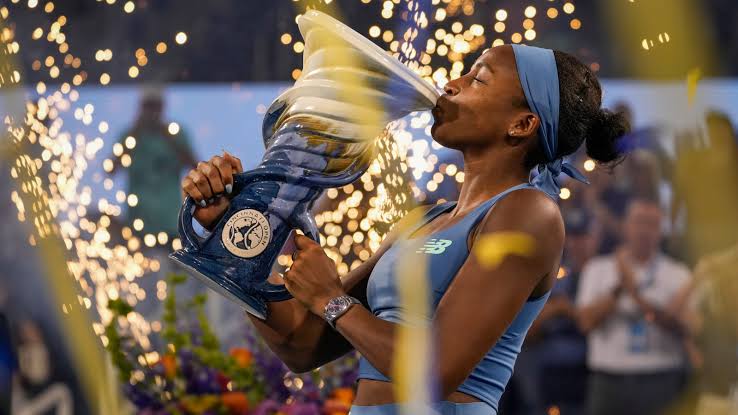


The final Grand Slam of the season arrives with the North American hard-court swing providing a revealing, if imperfect, guide to the US Open title race. The Canadian Open and Cincinnati Open have delivered new champions, deep runs and demanding three-set battles—results that create a familiar dilemma before Flushing Meadows: is recent momentum more valuable than arriving physically fresh? Ben Shelton and Iga Swiatek took the Canadian crowns, while Arthur Fils and Coco Gauff emerged victorious in Cincinnati, ensuring that New York will begin with several players carrying belief as well as accumulated court time.
1. Coco Gauff
Gauff enters her home Grand Slam with the strongest immediate momentum on the women’s side. The American defeated compatriot Jessica Pegula 6-2, 6-4 to claim the Cincinnati title, a performance that combined controlled aggression with the ability to manage the pressure of a high-profile final. Winning immediately before the US Open can bring fatigue, particularly after a long WTA 1000 campaign, but Gauff’s confidence on hard courts and familiarity with the New York spotlight make her the player to beat. Her title-winning run should give her rhythm, while the challenge will be preserving emotional and physical energy across seven demanding rounds.
2. Ben Shelton
Shelton’s Canadian Open defence was more than a successful title retention—it was a statement that his big-serving game can consistently deliver at Masters level. He beat Brandon Nakashima 6-3, 7-6(4) in an all-American final to secure a second straight Canadian Open crown and his second Masters 1000 title. The left-hander’s serve and explosive forehand make him especially dangerous in New York’s faster conditions, while local support could add another dimension. The key question is whether he can maintain his intensity through best-of-five-set matches, but his Canadian showing suggests he enters the Slam at precisely the right moment.
3. Iga Swiatek
Swiatek ended her wait for a title in 2026 with a highly convincing Canadian Open victory, beating world No. 2 Elena Rybakina 6-2, 6-3 in the Toronto final. That result matters because it showed Swiatek can impose her baseline game on a hard court against one of the tour’s most powerful opponents. She will have to recover quickly from the hard-court build-up, but the psychological lift of winning her first trophy of the season could outweigh any concerns about mileage. A six-time major champion, Swiatek has the experience and tactical flexibility to navigate the uneven early rounds that often shape a US Open campaign.olympics+1
4. Arthur Fils
The men’s Cincinnati title belongs to Arthur Fils after the Frenchman beat Frances Tiafoe 6-3, 1-6, 6-0 in a fluctuating final. The scoreline captured both his potential and the volatility of his game: Fils absorbed a second-set setback, reset quickly and finished with authority. That ability to respond is a major asset in a Grand Slam, where momentum can change dramatically across five sets. The concern is workload and expectation; a Masters breakthrough brings attention, and an extended Cincinnati run leaves limited recovery time. Still, he arrives as one of the most dangerous players outside the established favourites.atptour+1
5. Elena Rybakina
Although she lost the Canadian final to Swiatek, Rybakina remains a leading US Open threat because her serve-first game is tailor-made for hard courts. She was also the defending Cincinnati champion entering the Ohio event, evidence of her recent success in these conditions. A defeat shortly before a Grand Slam can sometimes be useful: rather than carrying the demands of a title run, Rybakina can reset, assess what did not work in Toronto and approach New York with fresher legs. If her first serve is firing, few opponents can dictate exchanges against her.
The US Open will not simply reward the player who won the most in August. The champion must blend confidence with recovery, handle humid conditions and survive the mental strain of two weeks under the lights in New York. Gauff, Shelton, Swiatek, Fils and Rybakina each possess the form to contend, but the player who best balances momentum with endurance will have the clearest route to lifting the season’s final major trophy.