
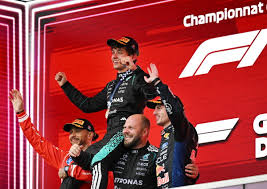


Kimi Antonelli’s victory at the Canadian Grand Prix was not just another win in a breakthrough season. It was his fourth straight triumph of 2026, a result that confirmed something increasingly difficult to ignore: the young Italian is not simply keeping pace with Formula 1’s biggest names, he is beginning to set the tempo himself. In a championship fight defined by pressure, experience, and mechanical fragility, Montreal offered a clear picture of a driver who is handling the spotlight with uncommon calm.
The Canadian Grand Prix demanded more than speed. Antonelli had to manage an intense internal battle with George Russell before his teammate’s race ended in heartbreak with a power unit failure and DNF. That sort of shift can destabilize even the most composed drivers. One moment the race is a duel inside the same garage; the next, the strategic picture changes completely and the burden of responsibility lands squarely on one set of shoulders. Antonelli absorbed that change without visible hesitation, which says as much about his mental strength as his raw pace.
What makes this run more impressive is the company he is beating. Lewis Hamilton and Max Verstappen are not ordinary rivals; they are the reference points of modern Formula 1. Both have spent years proving that championship pressure can be turned into performance, and both are used to forcing younger drivers into mistakes. Yet Antonelli has repeatedly refused to look rushed. His driving has been measured, patient, and efficient, which is often the difference between a talented rookie and a genuine title contender.
The key to his rise is composure under layered pressure. Antonelli is not winning because he is simply faster in clean air. He is winning because he understands race phases, tire life, traffic, and when to attack versus when to preserve. That maturity matters in a championship campaign, where the title is often decided by how well a driver handles the unglamorous stretches of a race rather than by one spectacular overtake. Montreal was a perfect example: Antonelli stayed locked in, resisted pressure from veterans, and converted a difficult contest into a composed victory.
There is also a larger psychological story here. Once a young driver starts leading the championship, every race becomes a test of identity. Is he a rising prospect riding momentum, or a true front-runner capable of carrying expectation week after week? Antonelli’s current form suggests the latter. Four wins in a row create their own kind of gravity, but they also bring the scrutiny that destroys many promising seasons. The challenge is not just speed; it is retaining the freedom to drive aggressively while knowing every mistake will be magnified.
Mercedes, for its part, appears to be giving him the right environment. A car that is competitive enough to win, combined with a structure that allows the driver to grow into the role rather than be consumed by it, has given Antonelli the platform to thrive. That balance is vital. Young champions are often overprotected or overexposed. Antonelli has so far managed to avoid both extremes. He looks supported, not sheltered, and ambitious, not reckless.
Montreal may turn out to be remembered as one of the decisive early chapters of his career. Winning in a field that includes Hamilton and Verstappen is one thing. Doing it while carrying championship pressure, surviving intra-team tension, and looking unshaken in the process is something else entirely. That is what makes Antonelli feel different right now. He is not merely a future star. He is already operating like a driver who believes the title belongs to him.