
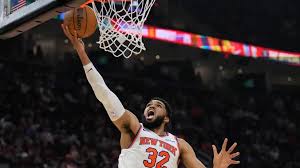


The NBA’s conference finals are delivering two very different, but equally telling, stories: one about history finally catching up to the New York Knicks, and another about the league’s future being shaped in real time by Shai Gilgeous-Alexander and Victor Wembanyama. The Knicks are back in the Finals for the first time since 1999 after sweeping Cleveland in emphatic fashion, while Oklahoma City now stands one win away from eliminating San Antonio in a series that has become a referendum on Wembanyama’s next step as a superstar.
New York’s run has been built on conviction, not coincidence. A 4-0 sweep of the Cavaliers, capped by a 130-93 demolition in Game 4, is the kind of performance that announces a team has moved beyond feel-good momentum and into serious championship territory. The Knicks have now won 10 straight postseason games, which is the sort of streak that changes how opponents talk about a team before tip-off even begins. There is confidence, and then there is the kind of collective belief that comes from repeatedly beating elite teams without needing a perfect night to do it.
What makes the Knicks’ march so compelling is that it feels earned through layers of toughness rather than one singular star takeover. Their defense has traveled, their rotations have held, and their ability to keep pressure on Cleveland across four games showed a team comfortable in the chaos of playoff basketball. A 37-point conference finals win is not just domination; it is a warning to the rest of the league that New York’s rise is no longer a surprise story.
Out West, the tone is different but no less significant. Oklahoma City’s 3-2 lead over San Antonio has put the Thunder on the cusp of the Finals, with Shai Gilgeous-Alexander once again proving why he belongs in the conversation with the game’s defining offensive stars. His 32-point performance in Game 5 was a reminder that his scoring is not dependent on rhythm alone — it is sustained by control, timing, and the ability to bend defenses without forcing the issue. That is what makes him so dangerous in the postseason.
The more fascinating subplot, though, is Wembanyama. Held to 20 points on 15 shots, he found himself at the center of a very public coaching challenge when Spurs coach Mitch Johnson urged him to take more attempts. That kind of message says a lot. The Spurs are not simply asking for greater aggression; they are trying to unlock the full scale of what Wembanyama can become as a playoff driver rather than just an elite two-way presence. When a player with his size, skill, and gravity is not fully involved offensively, the whole system can stall.
That tension makes Game 6 in San Antonio one of the most revealing nights of the postseason. Can the Spurs force a longer series by feeding Wembanyama early and often? Or will Oklahoma City continue to exploit its balance, athleticism, and shot-making edge to close the door? The answer will matter not just for this series but for how the league views the next generation of elite bigs and perimeter creators.
The All-NBA First Team selections for Gilgeous-Alexander and Wembanyama reinforce that shift. The league is clearly entering a new phase, one where younger stars are no longer waiting for permission to lead. SGA is already carrying a contender like a veteran closer, while Wembanyama is being asked to accelerate his evolution under playoff pressure. Together, they represent the changing face of the NBA.
For the Knicks, the Finals berth is a breakthrough rooted in discipline and resilience. For the Thunder and Spurs, the series is a preview of the league’s future, where every game feels like a handoff between eras. One team is finally back where it once belonged. The others are trying to decide who will define what comes next.