
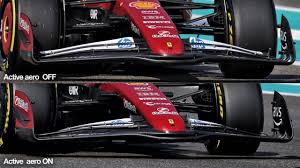


Formula 1’s 2026 “New Era” ignites global frenzy even before engines roar, with Williams and Ferrari unveiling striking liveries while Red Bull grapples with Helmut Marko’s exit and McLaren’s Lando Norris defending his crown. Amid pre-season testing buzz, the true game-changer lies in active aerodynamics—front and rear wings that morph mid-lap between “Z-mode” high-downforce cornering and “X-mode” low-drag straights—poised to transform overtaking from art to science.
These regs mandate a two-element active front wing and three-element rear wing, ditching DRS for driver-controlled switches. Z-mode deploys full flap angles for grip, generating 30% more downforce than 2025 cars through optimized endplates and floor edges, ideal for hairpin apexes where lateral G-forces peak. X-mode flattens elements—reducing drag by 55% overall—unleashing straight-line speeds up to 10km/h faster, complementing power units now drawing nearly 50% energy from a beefed-up 350kW MGU-K. Driver triggers activate X-mode in designated zones (like Suzuka’s 130R or Spa’s Kemmel), reverting via brake pressure or manual override, ensuring balance without lopsided aero stalls.
Overtaking evolves dramatically. Current dirty air—turbulent wakes slashing following grip by 40%—gets neutralized as trailing cars deploy X-mode simultaneously when within 1-second proximity, per FIA logic. This “manual DRS” grants both burst energy and reduced drag, enabling dives into braking zones rather than straight-line passes alone. Simulations show pursuers gaining 0.5-0.8 seconds per activation, stacking with overtaking boost systems for multi-car trains. Corner re-passes become viable: lead cars stuck in Z-mode lose straights, while chasers slingshot with X-mode momentum, flipping positions at Lesmo or Copse.
Teams adapt uniquely. Ferrari’s SF-26 livery hints at intricate wing linkages for seamless transitions, leveraging Maranello’s CFD edge to minimize balance shifts—front/rear sync prevents understeer plows. Williams, post-Sunderland revamp, prioritizes robust actuators for reliability, crucial as X-mode windows demand split-second timing. Red Bull’s post-Marko turbulence tests this: their RB-26 must nail mode stability amid Lawson-Perez lineup flux, or risk Norris exploiting McLaren’s Mercedes power in MCL-36 drags.
Technical ripple effects abound. Smaller, 30kg lighter chassis (downforce-to-weight jumps 10%) amplify mode switches, with narrower tracks enhancing close racing. Power unit symbiosis shines: X-mode’s drag cut feeds battery regen, fueling Z-mode pushes—hybrids hit 1,000+hp peaks. Pitfalls? Actuator failures could strand cars in high-drag, costing laps; FIA tokens limit wing range, curbing sandbagging. Testing data leaks show 55% less baseline drag, but overtaking hinges on software: AI-assisted triggers predict zones, blending driver instinct with data.
For global fans, this resets F1’s DNA. Gone are processionals; expect 40+ overtakes per race, rivaling IndyCar packs. Norris eyes three-peats; Verstappen rebuilds. As Bahrain testing wraps, active aero promises chaos—X-mode launches, Z-mode defenses—in the purest racing renaissance. 2026 doesn’t tweak; it redefines speed’s edge.