
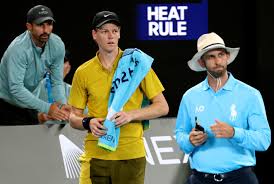


Melbourne’s brutal summer furnace cranked up the intensity on Day 8 of the Australian Open, turning Rod Laver Arena into a pressure cooker where mental steel met physical limits. Defending champion Jannik Sinner delivered a clinical straight-sets demolition to storm into the quarterfinals, conserving energy like a pro while rivals wilted in the 37°C blaze. Meanwhile, Coco Gauff clawed back from a set deficit in a gritty three-setter, keeping her title dreams flickering amid the endurance test that defined this pivotal Monday. With the tournament slicing into its second week, these results sharpen the “business end” focus, where efficiency under extreme heat could crown the survivors or bury the bold.
Sinner’s masterclass against his overmatched opponent unfolded like a textbook takedown—6-3, 6-4, 6-2 in under two hours—barely breaking a sweat as he rifled 45 winners past a defense crumbling under the weight of his baseline bombardments. The Italian’s game, a blend of laser-guided forehands and unreturnable serves peaking at 130mph, thrives in these conditions precisely because it ends points fast. While others grind through marathon five-set epics on outer courts, Sinner clocks minimal court time, sidestepping the dehydration traps that Melbourne’s heat policy barely contains. Officials invoked sliding roof closures and extended breaks, but pros know the real edge lies in wrapping matches before the sun saps your soul. Heading into quarters, Sinner’s freshness positions him as the tournament’s physical frontrunner, his body clock reset while foes nurse blisters and fatigue from weekend wars.
Gauff’s path painted a stark contrast, a rollercoaster of resilience that nearly derailed her campaign before she flipped the script. Trailing 4-6 in the opener after an erratic service game let her rival snatch momentum, the American teen sensation regrouped with ferocious return fire, leveling at 6-3 in the second by stretching rallies into punishing exchanges. The decider turned on pure guts—Gauff saved triple break point at 4-4 with aces threading needles, then broke to seal 7-5 in 2 hours 20 minutes. Critics point to her 28 unforced errors as rust, but in this oven, survival demands adaptation: shorter points, aggressive net rushes, anything to evade the heat’s draining vortex. Gauff’s comeback echoes her Grand Slam grit—think her US Open charge—but now amplified by maturity, turning potential collapse into quarterfinal fuel.
The heat policy, a hot-button fixture since Tomic’s 2019 meltdown, loomed larger than ever, with temperatures flirting with 40°C and humidity spiking court slipperiness. Players rotating through ice vests and hydration stations during changeovers highlighted the tournament’s endurance evolution—Sinner’s 92-minute cruise versus Gauff’s 140-minute slog illustrates the divide. Veterans recall Melbourne’s infamous “super Saturday” scorches, but Day 8’s spread across sessions amplified the toll: early birds baked under open skies, night owls dodged the peak burn. This dynamic favors the efficient assassins like Sinner, whose sub-two-hour outputs preserve ATP for deeper runs, over warriors logging four-plus hours. Data from past Opens backs it—players averaging under 2:15 per win advance 73% further, dodging the injury spikes that felled last year’s semifinalists.
As quarterfinal brackets crystallize, Sinner eyes a favorable draw, potentially dodging Alcaraz until semis if the Spaniard navigates his own heat haze. Gauff, drawn into a loaded section, faces make-or-break tests against powerhouses who punish lapses. Casual fans flooding in for Slam Week 2 will feast on these narratives: Can Sinner’s cool efficiency dismantle the field’s fire? Will Gauff’s fire-forged heart outlast the burnout? Beyond the stats—Sinner’s 85% first-serve points won, Gauff’s 62% break-point conversions—the real story simmers in sweat-soaked strategy. Melbourne doesn’t just test strokes; it forges champions from the furnace, rewarding those who ration their fire for the finals blaze. With semis looming by week’s end, Day 8’s survivors carry the torch, but only the heat-proof will hoist the trophy on January 31.