
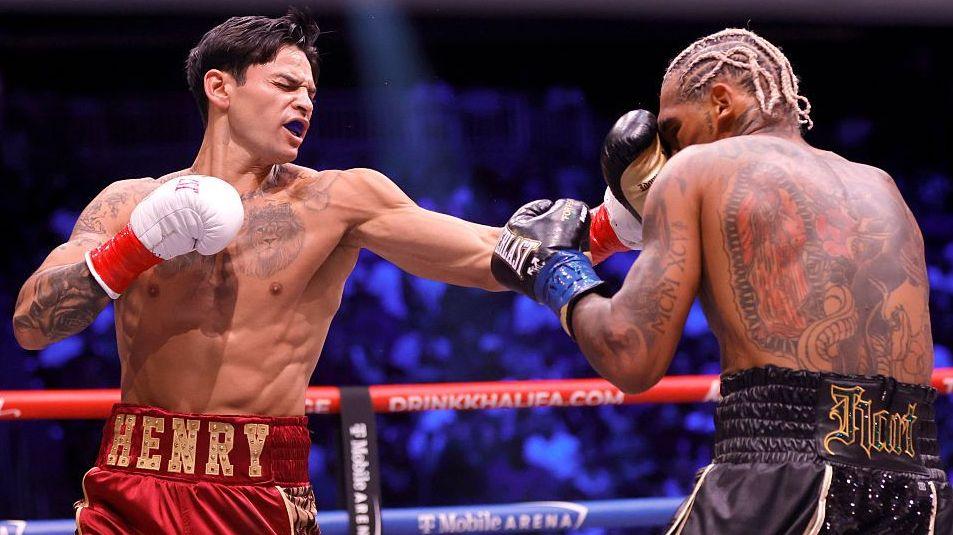


Ryan Garcia’s showdown with Conor Benn was expected to produce a tense tactical battle between an aggressive pressure fighter and one of boxing’s most dangerous counter-punchers. Instead, the WBC welterweight champion delivered a devastating statement at T-Mobile Arena in Las Vegas, stopping Benn by technical knockout at 1:25 of the second round. Garcia dropped the British challenger with a right hand before forcing the referee to intervene during a follow-up barrage.
The result was decisive, but the tactical explanation goes beyond a single power punch. Benn entered with the intention of taking the initiative. His preferred approach is to move forward quickly, close the distance and force opponents to fight while retreating. Against Garcia, that plan required intelligent pressure rather than simple aggression. Benn needed to make the American work defensively, attack the body and prevent him from finding the mid-range space where his counters are most dangerous.
Garcia, however, remained composed. His footwork allowed him to avoid being trapped along the ropes, while his timing punished Benn’s forward movement. The pre-fight focus was naturally placed on Garcia’s famous counter left hook, but the decisive blow came from his right hand. That detail was important because it showed the broader development of Garcia’s offence. Benn could not simply anticipate the hook; he had to account for straight punches, changes in rhythm and combinations arriving from different angles.
Benn’s front-foot style became a liability when his entries were not disguised. Garcia was able to read the distance, set his feet and fire before Benn could establish a sustained exchange. Once Benn was hurt, the fight changed instantly. The challenger’s need to recover was met by Garcia’s speed and accuracy, leaving little room for a controlled reset.
The stoppage also raises questions about Benn’s return to the welterweight division. Making the 147-pound limit had reportedly been physically demanding, and the contest offered no opportunity to determine whether his strength and stamina would improve over the distance. The defeat does not erase his previous victories, but it does suggest that his next step should involve rebuilding rather than immediately accepting another high-risk title opportunity.
For Garcia, the victory has transformed a high-profile defence into a career-defining moment. He retained the WBC title, improved his record to 26-2 with 21 knockouts and secured his first successful defence of the belt. More importantly, he demonstrated that he could manage an opponent who intended to overwhelm him early.
The welterweight division now offers several commercially attractive possibilities. Garcia has already called out Teofimo Lopez and Devin Haney, creating the possibility of a major rivalry or a rematch narrative depending on negotiations. A fight with Lopez would present a battle between speed, timing and explosive counterpunching, while Haney would offer a more technical contest built around distance control, jabbing and defensive discipline.
There is also the question of whether Garcia should pursue unification or prioritise the biggest available event. His victory strengthens his bargaining position, but the division remains crowded with champions and elite contenders. The most meaningful next opponent should test more than his popularity; it should challenge the areas Benn could not reach.
The aftermath of Garcia–Benn is therefore clear. Benn’s aggression was neutralised before it could mature into sustained pressure, while Garcia’s timing and power turned a competitive stylistic theory into a one-sided result. The champion now stands as one of the division’s biggest forces, and his next decision will determine whether this was simply a spectacular defence or the beginning of a dominant welterweight reign.