
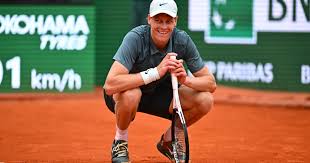


The modern tennis landscape is no stranger to eras of absolute control, but what the sports world is witnessing right now feels less like a temporary hot streak and more like a permanent shifting of the tectonic plates. With his historic victory at the Italian Open, Jannik Sinner didn’t just pick up another trophy; he completed a flawless sweep of the first five Masters events of the season and secured a historic Career Golden Masters. While standard match reports will focus on the scorelines and the silverware, the true story lies beneath the surface. To understand how this unprecedented dominance was achieved, one must look at the profound mechanical and psychological evolution the Italian has undergone over the last twelve months—a transformation that mirrors the legendary early-career leaps of Roger Federer and Novak Djokovic.
Not long ago, Sinner was viewed as a phenomenal ball-striker who occasionally struggled with physical durability and the tactical variety required to unlock defensive specialists on slower surfaces. Today, those vulnerabilities have been completely erased through a meticulous overhaul of his baseline mechanics. The most notable shift has occurred in his lower-body kinetics and court positioning. Sinner has shortened his backswing ever so slightly, allowing him to take the ball even earlier on the rise without sacrificing an ounce of his trademark power. This subtle adjustment gives his opponents virtually zero reaction time, turning ordinary baseline rallies into an claustrophobic experience for whoever is standing across the net. Furthermore, his open-stance movement on clay and hard courts has reached a level of fluid efficiency that allows him to transition from desperate defense to lethal offense in a single stride, effectively neutralizing the best counter-punchers in the world.
Beyond the biomechanics, the psychological armor Sinner has developed is what truly separates him from his contemporaries. His current run evokes memories of Novak Djokovic’s legendary 2011 season, a period defined by an unwavering, almost robotic belief in one’s own tactical system during high-pressure moments. Where a younger Sinner might have let a missed break point linger into the next service game, the current version operates with a short memory and an elite level of mental stamina. He treats crucial deuce points with the exact same technical discipline as an opening game, wearing opponents down mentally long before the final point is won. This ability to maintain peak focus across multiple grueling tournaments back-to-back is the ultimate hallmark of an all-time great.
What makes this historic milestone so fascinating is how it redefines the trajectory of his entire career. When Roger Federer first figured out how to balance his immense talent with emotional discipline in the early 2000s, the men’s tour was pushed into a completely new era of excellence. Sinner’s current dominance represents a similar evolutionary step for the sport. He has taken the relentless baseline aggression of the modern game and married it to a sophisticated, chess-like tactical awareness. By conquering five consecutive Masters titles on vastly different playing conditions, the Italian has proven that his technical foundation is completely bulletproof. We are no longer watching a young prodigy finding his footing; we are witnessing a master technician at the absolute peak of his powers, rewriting the boundaries of what is possible on a tennis court.