
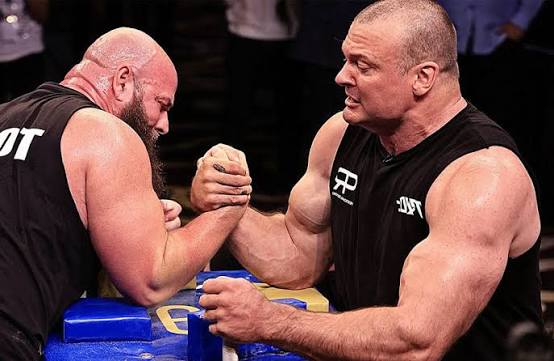


Arm wrestling is often presented as a simple test of strength, but elite supermatches are usually decided before the shoulders and biceps become the main story. The first major battle takes place at the hands, where wrist position, finger control and forearm rotation determine who owns the better leverage.
That is why the contrast between the outside toproll and the inside surge has become one of the most fascinating tactical themes in modern arm wrestling. A toproll aims to attack the opponent’s fingers, apply pronation and pull backward to open the wrist. The inside game, generally built around a hook, seeks to cup the hand, bring the opponent closer and turn the contest into a short-range battle.
The central link between both styles is wrist flexion. A puller who can maintain a strong, cupped wrist can preserve his structure and prevent the opponent from gaining easy access to the fingers. Once the wrist begins to flatten, however, the hand loses part of its leverage and the opponent can redirect the match.
In a toproll, wrist control is used to create distance. The attacking puller tries to rise through the hand, pronate over the opponent’s fingers and drag the grip toward the outside. This action does not necessarily require a direct battle against the opponent’s strongest arm position. Instead, it attempts to lengthen the opponent’s lever, weaken the fingers and force the wrist backward.
The best toprollers are not simply pulling sideways. They combine back pressure, rising and pronation while keeping enough wrist integrity to avoid being drawn inside. If the wrist collapses too early, the move loses its technical advantage and the attacker may be caught in an awkward position between the outside and inside lanes.
The hook represents the opposite tactical idea. Rather than creating space, the hook closes it. The puller cups the wrist, supinates the hand and brings the opponent into a compressed battle where elbow flexion, forearm strength and side pressure become increasingly important. In this position, wrist flexion helps shorten the effective lever and makes it more difficult for the opponent to rotate freely.
This is where East-versus-West matchups become especially intriguing. Pullers from different training cultures may arrive with contrasting preferences in grip height, hand containment and transition timing. A Western-style defensive specialist may willingly absorb the first hit before searching for a counter, while an Eastern European puller may attempt to win the hand immediately through aggressive rising, pronation or inside pressure.
Hand size adds another layer to the tactical equation. Larger hands can cover more of the opponent’s fingers and create stronger containment, while long fingers may help a toproller attack the grip from above. However, size alone does not decide the exchange. Wrist flexion, thumb security, finger endurance and the ability to change direction under pressure can neutralise physical advantages.
The most dangerous competitors are therefore hybrid pullers. They can begin with an outside attack, sense the opponent’s wrist weakening and then transition into an inside surge. Others may use a defensive hook to absorb the initial toproll before climbing back over the hand. These transitions often decide supermatches because the opponent is forced to react while already operating from a compromised wrist position.
As East vs West and King of the Table continue to showcase elite international talent, technical battles at the hand will remain central to the sport’s evolution. The next wave of supermatches may not be decided by who has the biggest arm, but by who can flex, rotate and reposition the wrist at the exact moment the opponent begins to lose control.