
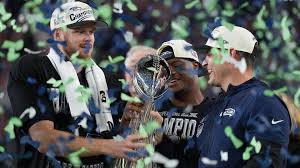


Levi’s Stadium in Santa Clara transformed into a Seahawks’ fortress on February 8, 2026, as Seattle clinched their second Super Bowl title, dismantling the New England Patriots 29-13 in a masterclass of tactical shutdown. Mike Macdonald’s defense, the NFL’s stingiest unit all season, suffocated Bill Belichick’s offense into scoreless silence through three quarters, allowing just 67 total yards while forcing three turnovers. Geno Smith’s pinpoint strikes—192 yards, two touchdowns—paired with Kenneth Walker III’s MVP rampage (135 rushing yards, bulldozing defenders for a 22-yard score), etched history. Walker’s haul made him the first running back Super Bowl MVP since Terrell Davis in 1997, validating Seattle’s ground-and-pound revival.
Macdonald’s blueprint was poetry in pads: a hybrid 3-4 front blitzing edges like Boye Mafe (two sacks) while linebackers Tyrel Dodson and Devon Witherspoon blanketed underneath zones, holding Pats’ Rhamondre Stevenson to 28 yards on 14 carries. New England’s Drake Maye, the rookie phenom, faced nightmares—intercepted twice by Julian Love, sacked four times total—averaging 3.2 yards per dropback. Seattle’s secondary, dubbed “Legion of Boom 2.0,” dropped eight into coverage on key third downs, baiting checkdowns into incompletions. By halftime, Patriots mustered 3 points; Macdonald adjusted post-break with simulated pressures, collapsing pockets before Maye planted. This wasn’t bend-don’t-break—it was premeditated demolition, limiting Belichick to 4-of-14 third-down conversions.
Walker’s MVP nod crowned a breakout: 148 yards from scrimmage, grinding out first downs on stacked boxes, his spin moves evading 312-pound nose tackle Christian Barmore. Jason Myers etched lore, nailing five field goals—including a 52-yarder into wind gusts—surpassing Super Bowl kicking records amid Levi’s swirling Santa Clara breezes. Smith’s veteran calm shone: a 36-yard dime to Jaxon Smith-Njigba ignited the rout, while Zach Charbonnet’s 42 yards off the bench sealed clock control. Pats’ lone rally—a late Drake London touchdown—came too tardy, Seattle’s 16-point lead unassailable.
Kicker Myers’ boot wasn’t luck; his 94% season clip thrived on holder Michael Dickson’s poise and snapper Chris Stoll’s rifle accuracy, converting under duress when Walker faced eight-man fronts. Macdonald’s chess countered Belichick’s wrinkles—no-huddle shifts met with pre-snap disguises, forcing conservative calls that fueled Seattle’s 28:42 time of possession edge.
Global ripples amplified the triumph. NBC’s broadcast shattered records at 124.9 million U.S. viewers, topping Super Bowl LVIII’s 123.4 million, with streaming spikes in Canada and Mexico pushing worldwide past 200 million. Bad Bunny’s halftime supernova—reggaeton anthems fused with mariachi horns, guest spots from Peso Pluma—racked 4 billion social impressions, 55% international (Latin America 28%, Europe 15%, Asia 12%). Clips of Walker’s stiff-arms and Macdonald’s sideline pumps trended #SuperBowlLX globally, NBA stars like LeBron James hailing Seattle’s “new dynasty dawning.”
Seattle’s encore—first title since Wilson’s 2013-14 back-to-back—ushers Mike Macdonald, 39, into coaching pantheon, his Baltimore Ravens roots evolving Pete Carroll’s legacy. Walker, 25, emerges RB1 heir to Marshawn Lynch, while Myers’ leg anchors special teams lore. As confetti fell, Belichick’s postgame nod—”flawless execution”—sealed respect. Super Bowl LX wasn’t mere win; it was defensive doctrine dominating, global eyes witnessing Seahawks’ symphony rewrite NFL history.