
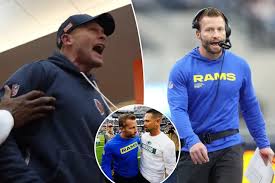


When the Los Angeles Rams face the Chicago Bears in the NFC Divisional Round on January 18, 2026, football purists will tune in less for the star running backs or quarterback duels and more for the sideline cerebral war between Sean McVay and Ben Johnson. This matchup pits McVay’s Hollywood-scripted precision against Johnson’s audacious play-calling, turning Soldier Field into a chessboard where schematic innovation trumps raw athleticism. Both coaches have transformed struggling franchises into playoff threats through offensive wizardry, making this less a slugfest and more a masterclass in adapting schemes to personnel.
McVay, the 39-year-old Rams architect, built his legend on pre-snap motion and misdirection that befuddles linebackers. His Shanahan-tree roots shine in play-action boots and RPOs that exploit zone coverages, averaging 28.7 points per game during the regular season. On the road, the Rams went 8-1 to the over, showcasing McVay’s knack for high-scoring outputs away from SoFi Stadium—think his 2025 wild-card clinic against the Vikings, where he force-fed screens to Kyren Williams amid blitzes. Against Chicago’s rigid defense, anchored by Pro Bowl safety Jaquan Brisker, McVay will test vertical seams, likely deploying bunch formations to create rubs for Puka Nacua’s yards-after-catch magic.
Enter Ben Johnson, Chicago’s 38-year-old offensive coordinator turned interim head man, whose meteoric rise from Lions OC to Bears savior has fans buzzing. Johnson’s hallmark is tempo: no-huddle snaps that wear down fronts, blending bootlegs with gap-scheme runs at a league-high 65% play-action rate. The Bears’ resurgence—10-7 record and home playoff edge—stems from his post-game adjustments, like the Week 17 tempo barrage that torched Green Bay for 37 points. At Soldier Field’s frosty confines, Johnson’s wrinkle could be jet motion into counter-RPOs, forcing Chicago’s defense to declare early and exposing edges for D’Andre Swift. Yet McVay’s veteran poise—two Super Bowl rings—gives him the edge in two-minute drills, where he’s converted 68% of late-game drives into points.
This chess match thrives on contrasts. McVay favors deliberate build-ups, using max protect to let Matthew Stafford diagnose secondaries, while Johnson thrives in chaos, scripting four-wide sets that stretch safeties thin. Rams road overs highlight McVay’s explosive bursts—over 30 points in seven of nine away wins—but Chicago’s home defense concedes just 18.2 per game indoors, ranking top-five in red-zone stands. Johnson’s counter? Aggressive downfield shots (Caleb Williams’ 9.2 yards per attempt), daring Rams corners to match speed in man coverage. Expect McVay to shadow with nickel packages, forcing Johnson to grind clock via inside zone—where Bears rank eighth in yards before contact.
The broader NFC narrative amplifies stakes: McVay chases a third straight deep run, blending vets like Stafford with young blood, while Johnson’s Bears embody rebuild alchemy, turning a 4-13 squad into contenders. Whichever scheme blinks first dictates NFC Championship fate—McVay’s patience versus Johnson’s unpredictability. Soldier Field’s windswept lore adds pressure; historic upsets favor the bolder caller. As whistles blow, this isn’t about yards or touchdowns alone—it’s two savants dissecting tendencies in real time, scripting football’s next evolution. Rams fans dream of McVay’s encore; Bears backers bank on Johnson’s spark. In coaching’s grand arena, genius collides.