
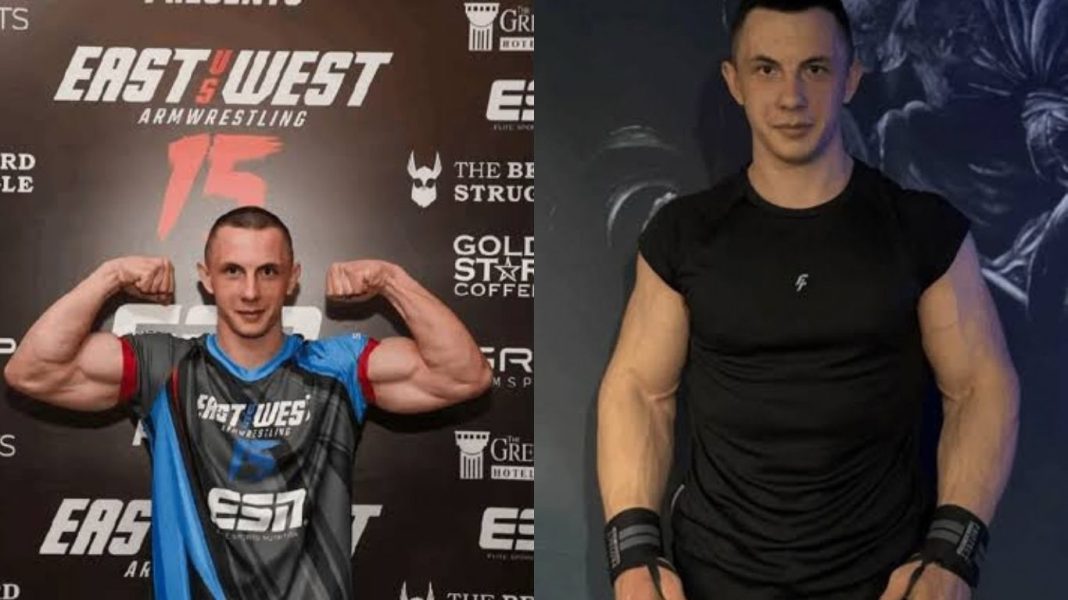


In a sport increasingly dominated by conversations about size and raw mass, Danil Ustinov — often billed internationally as Daniel Ustinov — stands as a compelling reminder that technical mastery can be just as devastating as brute strength. Representing Kazakhstan, a nation widely regarded as one of the true powerhouses of competitive arm wrestling, Ustinov has carved out a reputation as one of the sport’s most accomplished lightweight competitors, built not on overwhelming physicality but on precision, structure, and years of specialized training.
Standing at 5 feet 8 inches and competing primarily in the 70 kg and 75 kg weight classes, Ustinov’s physical profile reads almost like a blueprint for the ideal lightweight puller. Both his biceps and forearms measure an identical 41 centimeters, a rare 1:1 ratio that few competitors in the sport possess. That balance isn’t just an interesting statistic — it translates directly into exceptional structural integrity at the table, giving him the kind of hand control and pronation strength that allows smaller-framed athletes to dominate positioning against opponents who might otherwise rely on size alone.
Ustinov’s championship pedigree speaks for itself. Frequently cited as an 11-time World Champion across various youth and senior weight categories, he has spent years accumulating results that place him firmly among the sport’s elite lightweight competitors. His most recent standout achievement came at the 2024 World Armwrestling Championship, where he captured gold in the 75 kg youth men’s right-hand division, further extending a championship résumé that already spanned nearly a decade of top-level competition. Earlier in his career, he also picked up a bronze medal in the 70 kg category at the 2023 World Armwrestling Championship, a tournament fittingly held on home soil in Almaty, Kazakhstan.
Beyond championship tournaments, Ustinov has become a fixture on the sport’s biggest promotional stages, regularly appearing in the prestigious East vs West series. One of his most talked-about outings came at East vs West 15, where he faced Armenia’s Azat Srapyan in a tightly contested featherweight title supermatch. Ustinov ultimately came out on top in a hard-fought contest that went the distance, a result that showcased not just his technical skill but his composure and endurance in a high-pressure, best-of-seven format against a determined opponent.
What makes Ustinov such an interesting case study within the sport is how directly his success ties back to the broader Kazakh arm-wrestling tradition. Kazakhstan has consistently produced technically flawless pullers over the past decade, and Ustinov represents very much the modern evolution of that lineage — an athlete whose game is built on fundamentals honed through specialized training environments rather than pure gym-built strength. It’s a style of competition that rewards patience, precision, and an intimate understanding of leverage over simply overpowering an opponent through mass.
That philosophy is perhaps best illustrated by Ustinov’s willingness to train alongside, and compete against, athletes considerably heavier than himself. He has spent time at renowned training environments such as the Arm Fight Factory in Georgia, where lightweight pullers are regularly pitted against significantly larger competitors as part of their development. Holding his own in that kind of environment requires a very specific skill set — using rising technique, back pressure, and precise angle control to neutralize size advantages rather than trying to match them directly. It’s a fascinating technical dimension of the sport that often goes unnoticed by casual fans, yet it’s exactly the kind of skill set that has allowed Ustinov to consistently punch above his weight class, quite literally, throughout his career.
At the heart of it all lies the anatomy that makes his game possible. In arm wrestling, matches are rarely decided by whoever is simply stronger overall — they’re decided at the hand and wrist, where control, pronation, and structural stability matter far more than total muscle mass. Ustinov’s matching 41 cm forearm and bicep measurements aren’t just a curious physical quirk; they represent a build almost perfectly adapted to absorbing an opponent’s initial force and redirecting it, a skill that becomes especially valuable in the tightly contested 70-75 kg weight classes where technical margins are razor thin.
As arm wrestling continues to grow in global visibility, competitors like Danil Ustinov offer a compelling counter-narrative to the sport’s obsession with size. His journey through the Kazakh system, his growing supermatch résumé, and his rare physical proportions all combine to make him one of the more fascinating lightweight athletes competing today — proof that in this sport, precision and structure can be just as lethal as raw power, if not more so.