
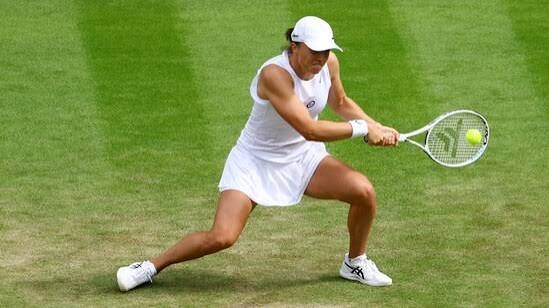


Iga Świątek captured her first title of the 2026 season with a commanding 6-2, 6-3 victory over world No. 2 Elena Rybakina in the Canadian Open final in Toronto, delivering a hard-court masterclass that showcased her evolving baseline game and tactical maturity just weeks before the US Open. The six-time Grand Slam champion, currently ranked world No. 8, ended an 11-month title drought by outplaying the reigning Australian Open champion in one hour and 15 minutes, converting both break point opportunities while saving two of her own to secure her 26th career WTA title. The victory at Sobeys Stadium not only silenced critics who questioned whether Świątek could maintain her dominance on hard courts but also established crucial momentum heading into the final Grand Slam of the year at Flushing Meadows.
Stroke analytics from the final reveal how Świątek managed Rybakina’s formidable first-serve power through superior court positioning and aggressive return positioning that disrupted the Kazakh’s rhythm from the baseline. Rybakina, who leads the tour in aces, managed just one ace throughout the match while committing four double faults and hitting only 13 winners against 23 unforced errors, a statistical profile that reflects Świątek’s ability to neutralize her opponent’s biggest weapon. The Polish star dropped just four points on her first serve after the opening game of the first set, winning 15 of 19 first-serve points to establish immediate control and prevent Rybakina from finding any sustained momentum.
Świątek’s court positioning adjustments proved decisive, as she consistently stepped inside the baseline to take time away from Rybakina and dictate rallies with her heavy forehand and improved backhand down the line. Her serve rating of 302 compared to Rybakina’s 201 demonstrated superior execution under pressure, while her 83% first-serve percentage (20 of 24) provided the foundation for aggressive baseline play that kept Rybakina on the defensive throughout. The world No. 8 won 80% of her first-serve points (16 of 20) and held all eight of her service games without facing a single break point in the second set, showcasing the serving consistency that had eluded her during her title drought.
The tactical breakdown reveals how Świątek exploited Rybakina’s second serve, winning 59% of those points compared to Rybakina’s 41% success rate on her own second delivery. This disparity created constant pressure on Rybakina’s service games, forcing her into defensive positions where Świątek’s superior movement and shot selection could dominate. The Polish star’s dominance ratio of 1.60 compared to Rybakina’s 0.63 illustrated comprehensive control across all statistical categories, from serve to return to baseline exchanges.
Świątek’s evolving baseline game featured increased variety in shot selection, including more frequent use of the drop shot and angled cross-court forehands that pulled Rybakina wide and opened up the court for winners. Her ability to switch between defensive retrieval and aggressive shot-making demonstrated the tactical flexibility that has defined her Grand Slam success, while her mental resilience after dropping the second set to Elina Svitolina in the semifinals showed championship character that will serve her well in New York.
The momentum heading into the US Open hard-court swing cannot be overstated, as Świątek now carries the confidence of defeating a top-2 opponent in straight sets on a surface that has historically favored power players like Rybakina. Her 12th WTA 1000 title and first at the Canadian Open provides tangible evidence that her game has evolved to handle the pace and bounce of North American hard courts, addressing concerns that emerged during her 11-month title drought. As the tennis world turns its attention to Flushing Meadows, Świątek’s Toronto performance sends a clear message to her rivals: the world’s best hard-court player has rediscovered her form at precisely the right moment.