
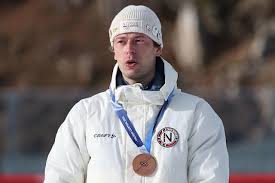


Amid the icy splendor of Milan-Cortina 2026 Winter Olympics, where February 6-22 showcases humanity’s defiance over snow and frost, Norwegian biathlete Sturla Holm Lægreid just clinched his second bronze on Valentine’s Day—a gritty pursuit race that silenced doubters but amplified his personal storm. The 28-year-old from Fagernes, already a Beijing 2022 double gold medalist, hit 19-of-20 targets under blustery skies at Tesino’s 12.5km loop, finishing 14.7 seconds behind Sweden’s Sebastian Samuelsson. Yet this medal, hot off the press, arrives not in triumph’s vacuum but amid tabloid frenzy over his private life—rumors of a breakup and media hounding that threaten to eclipse his rifle’s precision.
Biathlon demands superhuman duality: superhuman endurance fused with sniper calm, where a heartbeat’s tremor spells doom. Lægreid embodies this, logging 200km weekly on roller-skis in summer, then standing statue-still to drill 4.4mm bullseyes at 50m. His Feb 14 bronze—third after a mixed relay silver earlier—marks Norway’s podium dominance (15 medals already), but the real narrative pulses in his psyche. Pre-race leaks painted him as distracted, Norwegian outlets dissecting relationship woes with ex-partner and fellow athlete Hedda Østberg Amundsen. “Focus fire,” he quipped post-race, eyes steely behind fogged goggles, channeling mental fortitude honed by sports psychologist Randi Abrahamsen.
Pressure’s podium paradox tests elites uniquely. Psych studies, like those from IOC resilience labs, show 70% of Olympic medalists face off-mat turmoil—divorces, finances, scandals—yet winners reframe chaos as fuel. Lægreid’s toolkit mirrors this: pre-race visualization drills “anchor breaths,” inhaling calm amid chaos, exhaling doubt. Post-2022 burnout, when fame fractured focus (he admitted skipping family for training camps), he adopted mindfulness apps and journaling, scripting affirmations like “rifle steady, legs fire.” Feb 14’s near-perfect prone shooting (10/10) betrayed no wobble; standing stage, one miss cost gold, but recovery speed—skiing sub-32-minute splits—screamed composure. Off snow, he dodges pressers, posting Instagram cryptic: snowy peaks over gossip rags.
Norway’s biathlon machine amplifies stakes. With stars like Johannes Thingnes Bø grabbing golds, Lægreid shoulders “next gen” burden, media branding him heir apparent amid 2026’s 93-event frenzy. Personal headlines sting deeper in Scandinavia’s glare-all ethos, where athletes’ lives fuel Aftenposten fodder. Yet resilience blooms: recall Therese Johaug’s doping redemption or Ole Einar Bjørndalen’s divorce-fueled Beijing golds. Lægreid’s edge? Humble roots—Fagernes’ 1,800 souls taught grit via frozen ponds—and family armor. Brother Eirik Holm Lægreid competes nearby, forming a podium posse that buffers noise.
Mid-Games, Milan-Cortina pulses with tales beyond tallies: Italy leads medals (8), Norway chases, USA lags in freestyle. Lægreid’s arc inspires universally—proof mental armor trumps media missiles. As pursuits yield to relays, his bronzes signal more: mass start gold hunt awaits, where fortitude faces 20km gauntlet. In Olympics’ pressure cooker, where private whispers amplify public roars, Sturla proves podiums aren’t won by legs alone. Heart and head, forged in fire, claim glory. His story whispers to every athlete: headlines fade, triggers don’t.