
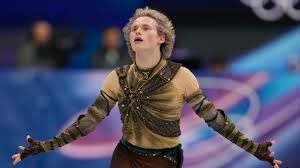


The Milano Cortina 2026 Winter Olympics pulse with high-stakes drama as Jutta Leerdam’s Dutch dominance in speed skating collides with figure skating’s razor-edge rivalry between America’s Ilia Malinin and Japan’s Yuma Kagiyama. Leerdam’s gold in the women’s 1,000m speed skate—clocking a blistering sub-1:13 barrier—affirms the Netherlands’ stranglehold on ovals, her third medal amplifying Europe’s skating supremacy. Yet all eyes pivot to the men’s figure skating free program on February 13, where Malinin’s short program lead of 108.16 over Kagiyama’s 103.07 sets a taut stage for technical Armageddon.
Malinin, the 21-year-old “Quad God,” isn’t merely competing—he’s shattering figure skating’s biomechanical frontiers. His short program precision, sans the risky quad Axel, built a five-point cushion through flawless quad lutz-triple toe combos and serpentine footwork that warps ice friction dynamics. Physics underpins his revolution: quads demand torque exceeding 500 Nm at takeoff, where angular momentum conservation (L=Iω) spikes via hyper-extended salchow rotations—Malinin hits 4.5 spins pre-landing, defying centrifugal forces that shred lesser skaters’ edges. Kagiyama’s triple Axel stumble exposed his edge; his planned free skate quad flip aims to counter, but Malinin’s seven-quad blueprint (including that elusive 4.5-rotation Axel) evokes relativistic speeds on blades, generating g-forces akin to Formula 1 corners.
This Olympic cycle marks figure skating’s quad explosion, evolving from Beijing 2022’s tentative triples to Malinin’s programmed insanity. Pre-2026, only 12 men landed competition quads consistently; now, Malinin’s 12-win streak post-2023 forces rivals like Kagiyama—Beijing silver medalist—and France’s Adam Siao Him Fa (102.55 short) into aerial arms races. Technical scoring, via ISU’s GOE multipliers, rewards Malinin’s risk: a clean quad salchow nets 12+ points, compounded by transitions that blend Einsteinian curvature (ice blades carving micro-Riemannian paths) with Newtonian impulse for seamless spins. Kagiyama counters with “flow state” precision—crisp edges minimizing drag—but Malinin’s backflips and Axels redefine limits, pushing rotational inertia beyond 3.0 kg·m² thresholds that buckled Nathan Chen’s era.
North American and European powerhouses dominate: USA’s team event redemption via Malinin vaults them toward medals, while Kagiyama’s Japan chases history against Siao Him Fa’s French flair. Malinin’s free skate, last in rotation, carries redemption weight after team event wobbles; a world-record 300+ total could eclipse Kagiyama’s aggression by 30 points, as in Grand Prix finals. Yet physics bites back—fatigue spikes error probability exponentially after quad four, where lactic thresholds crater blade control. Kagiyama’s quad flip dagger tests this: success flips momentum via higher base value (11.5 vs. Malinin’s Lutz 10.5), but Malinin’s torque mastery (from 20-hour blade drills) likely holds.
As Milano’s Palavelodrome roars, Malinin embodies skating’s new physics: human centrifuges conquering gravity’s tyranny. Leerdam’s oval tyranny parallels this—Europe-North America axis reigns, but Malinin’s quad quantum leap could solo-gild the Games. Kagiyama sweats blood for upset; physics, however, favors the God.