
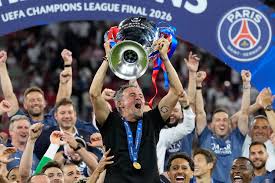


Paris Saint-Germain confirmed their place atop European football with a nervy, dramatic victory over Arsenal in Budapest, securing a second consecutive UEFA Champions League title. After 120 minutes ended 1-1, the final slipped into a tension-soaked penalty shootout where PSG’s composure edged out Arsenal 4-3 — a result that both caps a successful transitional era for the French club and leaves the Gunners ruing a cruel miss.
The match itself was a study in contrasts. PSG controlled large swathes of possession, probing with a fluid midfield and inventive wide play that frequently unsettled Arsenal’s backline. Yet Arsenal, organized and disciplined, repeatedly neutralized the most dangerous moments. William Saliba and Gabriel Magalhães led a defensive display full of timely interceptions, aerial dominance, and calm recovery runs that frustrated PSG’s attempts to break the compact lines.
Arsenal’s strategy was clear: absorb, disrupt, and strike when openings appeared. It nearly paid off. The Gunners matched intensity with clinical counterattacks, and when the breakthrough came, both sides produced moments of quality that reflected the stakes. PSG’s attacking impetus, underpinned by the dynamism of Khvicha Kvaratskhelia and incisive link-up play, found the net once; Arsenal’s resilience earned them an equaliser that forced extra time.
Extra time intensified the drama without resolving it. Fatigue crept into both squads, substitutions reshaped patterns, and tactical caution grew as managers weighed the risk of chasing a late winner against the minefield of a shootout. Neither side could deliver a decisive blow, and so fate turned to spot kicks — a stage that would highlight PSG’s mental readiness and Arsenal’s heartbreaking misfortune.
The shootout hinged on nerve and precision. PSG converted four of their attempts, while Arsenal matched them step for step until the fifth kick. Gabriel Magalhães — typically reliable on the biggest nights — saw his penalty saved, handing PSG a 4-3 victory and sparking wild celebrations from the Paris contingent. For Arsenal, the miss felt particularly cruel: months of meticulous tactical preparation and iron-clad defending dissolved in a single, agonising moment.
Beyond the immediate heartbreak for Arsenal, PSG’s triumph carries broader significance. The victory validates a pronounced shift at the Parc des Princes: a deliberate move away from building solely around aging superstars toward a more balanced, cohesion-led model blending youth, athleticism and smart recruitment. Kvaratskhelia’s influence throughout the campaign symbolised that evolution — a player who can destabilise defences, create chances, and inject pace into key phases. PSG’s midfield and defensive reinforcements have allowed coach Luis Enrique to deploy a system that functions less as a collection of individual talents and more as an integrated unit capable of weathering pressure and delivering in decisive moments.
Arsenal, meanwhile, have much to take from the performance despite the loss. Their defensive organisation and ability to nullify elite attacking threats demonstrated growth under pressure. The Gunners will console themselves with a display that proved they belong on this stage; the task now is converting experience into the fine margins that decide finals. Recovering from this setback will depend on mental resilience and measured recruitment to close gaps exposed by PSG’s tactical flexibility.
For PSG, back-to-back titles do not simply reflect a win in one final — they mark the successful implementation of a long-term project. The penalty shootout outcome was a narrow one, but it underscored a club culture that has expanded beyond marquee names to embrace a collective identity capable of delivering Europe’s highest prize twice in a row.
Arsenal leave Budapest with questions about fate and fortune, while PSG return to Paris with the trophy and a clear message: the club’s future is being built on cohesion, calculated youth investment, and the ability to perform under unbearable pressure — a blueprint that just won them Europe, again.