
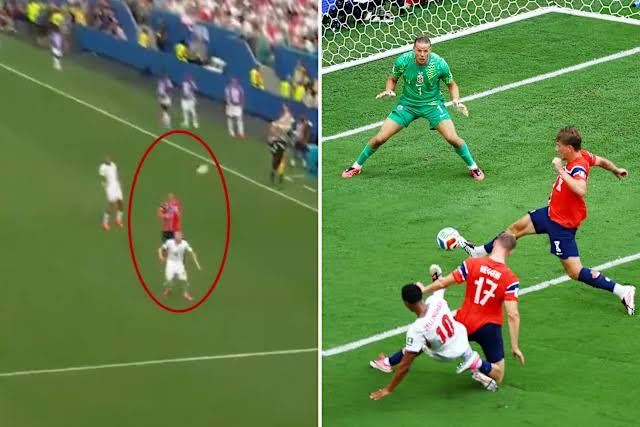


England’s win over Norway should have been remembered for football alone. Instead, it has turned into one of the tournament’s flashpoints, centred on a single goal and a debate about whether modern technology helped or failed the game. The controversy erupted when England scored from a move in which Norway insist the ball brushed a camera wire, changing direction just enough to deceive their defence and goalkeeper.
From the Norwegian perspective, the sequence looked anything but normal. Several players immediately protested, gesturing towards the sky and signalling that something was wrong with the ball’s flight. According to them, the trajectory shifted subtly but unnaturally, as if it had been nudged mid-air. In a tight game at this level, any unexpected deviation can be decisive, and Norway believe this microscopic moment altered the outcome.
Their frustration only grew when FIFA quickly released a statement backing the goal. The governing body leaned on the data, citing information from the on-ball sensor and other tracking systems that are designed to detect contacts and impacts. In FIFA’s version of events, those readings did not register any interaction between the ball and the overhead camera wire, meaning there was no technical evidence to support Norway’s claim. For the officials, that made the decision clear: the goal had to stand.
This clash between what players felt and what technology reported has become the heart of the story. Norwegian voices argue that you cannot reduce every incident to numbers alone. Several have been quoted saying variations of the same idea: that you “can see with your own eyes” the ball changing course, and that the sense of touch and instinct on the pitch still matter. They feel that, in the rush to defend the systems, their lived experience during the game has been dismissed.
On the other side, FIFA’s stance reflects the broader direction of elite football. The sport has increasingly turned to sensors, cameras and automated tracking to provide definitive answers. Whether it is goal-line technology, semi-automated offside decisions or ball-tracking for offsides and fouls, the message has consistently been that technology reduces human error. In this context, admitting that players’ impressions override machine data would undermine the core logic that has driven these investments.
For supporters, the incident has reopened familiar questions. How much trust should football place in technology, especially when it is installed so close to the field of play that it could influence the action? Overhead camera rigs are designed to enhance broadcasts, yet Norway’s complaint centres on the risk that this infrastructure might interfere with the game itself. If a wire can even potentially touch the ball, there will be pressure to rethink how and where these systems are set up.
The reaction online has been predictably intense. Norwegian fans view the goal as a symbol of imbalance, feeling that big teams benefit from grey areas while smaller sides are told to accept explanations they don’t fully believe. England supporters, meanwhile, mostly point to the official statement and emphasise that the laws of the game were applied using available evidence. Between these positions is a growing group of neutrals who sense that both sides raise valid points: technology can be useful, but it should never be beyond question.
The players’ insistence that the ball changed direction, even without sensor confirmation, highlights a deeper tension. Football’s emotional core has always rested on human judgment, intuition and the shared sense of what feels fair. When that clashes with numbers on a screen, mistrust can quickly spread. Whether or not the ball actually struck the wire, this controversy has reinforced how fragile confidence in the system can be, especially in high-stakes matches.
The England–Norway goal will now live on as a reference point in debates about broadcast technology, ball-tracking and transparency. For the game’s authorities, the challenge will be to show that enhancing the viewing experience does not come at the cost of the competition’s integrity. For players and fans, the hope is simple: when a ball hits the back of the net, the only thing that should matter is the quality of the football, not the position of a camera wire.