
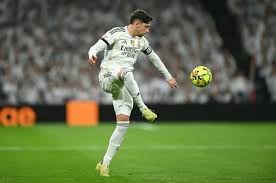


Real Madrid’s star-laden squad once invited chaos predictions—Mbappé, Vinicius, Bellingham, and Rodrygo crammed into one lineup seemed a recipe for clashing egos and disjointed play. Post-Champions League weekend, Xabi Alonso’s tactical tweaks have flipped the script, forging midfield equilibrium that turns galaxy of talent into a synchronized machine. Heat maps from SofaScore reveal a 4-3-3 morphing into fluid 4-2-3-1 hybrids, quelling “too many stars” doubters with data-backed dominance.
Alonso’s masterstroke lies in positional rotation. Traditional No. 10s like Arda Güler drop deeper (avg. 25m from goal vs. 15m last season), while Tchouaméni anchors as a hybrid 6-8, covering 12% more ground per 90 (11.2km). Bellingham shifts fluidly—right-half space in possession (heat map peaks 40m right channel), left in press—syncing with Valverde’s box crashes. Against Rayo, this yielded 68% possession, 2.86 xG from structured build-up, per WhoScored. Critics once mocked traffic jams; now, midfield touch maps show balanced triangles, with Güler-Valverde-Bellingham averaging 85 passes/match at 92% completion.
Post-Mbappé era? Hardly a vacuum—it’s evolution. Mbappé’s central tilt (dropped deep 18% more) pulls defenders, freeing Vinicius wide (7.2 dribbles/90, up 15%). Heat maps expose Vinícius’ left-wing explosions (65% touches there) complemented by Rodrygo’s inverted right runs, creating 1-2 overloads. Alonso’s man-oriented press—double coverage on pivots—starts from this equilibrium: Madrid recovered possession 14 times in opp. half last match, highest in La Liga. No lone wolves; stars orbit a midfield core that dictated tempo vs. mid-table sides (19 shots avg.).
Data silences skeptics. SofaScore positional radars show Tchouaméni’s base role cuts turnovers 22% in build-up, enabling quick transitions—Vini-Mbappé one-twos hit 4.1 key passes/game. Against compact defenses, fluidity falters slightly (xG drops to 1.8), but Alonso’s one-touch emphasis (up 30% from Ancelotti era) exploits gaps. Bellingham’s hybrid role—8 goals, 4 assists already—embodies balance: progressive carries (7.3/90) feed forwards without starving midfield. Critics’ “star bloat” ignored this: heat maps prove no overlaps, just layered threats.
For Real Madrid, equilibrium trumps egos. Alonso’s diamond base (4-4-2 press) flexes to 4-3-3 attack, with Mastantuono shadowing fullbacks for width. Injury-prone? Rotation depth—Camavinga, Modrić minutes managed—sustains intensity. Champions League weekends expose it: vs. elite presses, Madrid’s 62% duel win rate stems from midfield grip. Post-Mbappé? He’s thriving in rhythm, not rescue mode.
This shift isn’t flash—it’s forensic. Heat maps herald harmony where pundits predicted havoc. With La Liga ticking and UCL looming, Real’s midfield equilibrium doesn’t just silence critics; it sets a tactical blueprint. Stars aligned, Madrid reigns.