
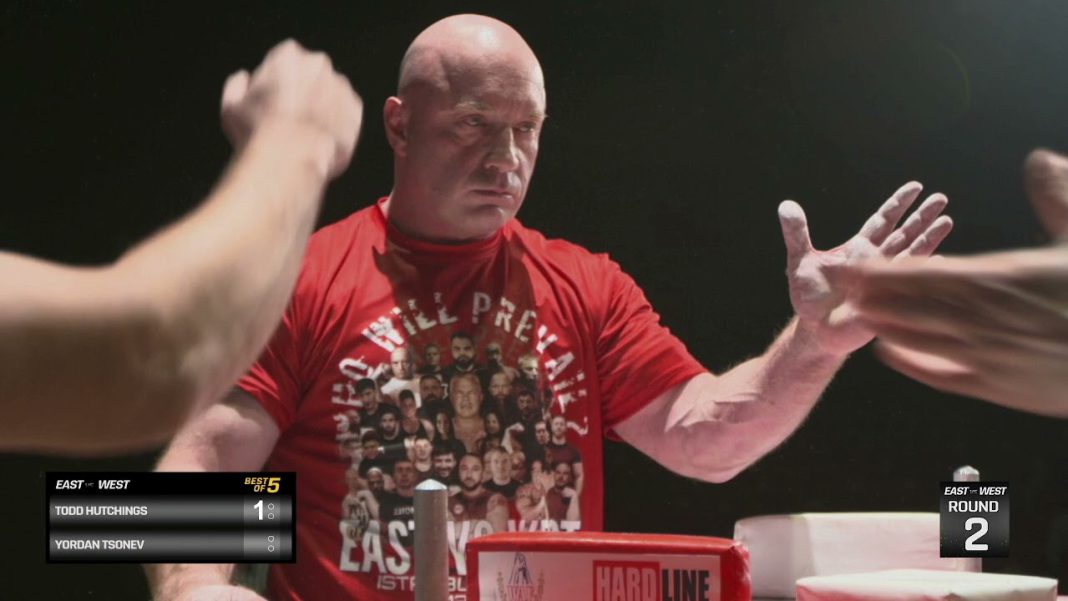


Most world-class athletes are shaped by their sport from childhood. Todd Hutchings did the opposite. He was already in his mid-thirties, with a career in engineering behind him, when he first sat down at an arm-wrestling table in the fall of 2000. More than two decades later, the American known as “Toddzilla” is still pulling at the highest level, still beating men far younger than himself, and still making a strong case that he is one of the most technically unusual champions the sport has ever seen.
Hutchings holds a master’s degree in mechanical engineering and works designing and testing industrial diesel fuel systems, a background that explains a great deal about how he approaches the table. Where many competitors rely on instinct and years of repetition from a young age, he came to arm wrestling with an analytical mind and a habit of breaking problems down into forces, angles and leverage. He applied that thinking to biomechanics and progressive overload, and the results arrived quickly. Within roughly five years of starting, he was already testing himself against the great John Brzenk, widely regarded as the greatest arm wrestler in history. For a man who began at 34, that kind of rise is almost unheard of.
Competing in the middleweight and light heavyweight ranges, usually somewhere around 95 to 105 kilograms, Hutchings is best known as an elite right-arm specialist, and his style is a textbook example of pure side pressure. While much of the modern sport has drifted toward hand control and defensive pronation built around the top-roll, Hutchings goes the other way. He drives his shoulder and torso sideways across the table, locking his frame into an angle that opponents struggle to disrupt. The goal is not to win the hand battle at all. When rivals try to crack his wrist back, he often simply lets it happen, pulling through a loose, floppy wrist and sending force directly through the elbow and the rotation of the humerus into the pad.
The approach has become so recognisable that fans have given it a name. The “Toddzilla Wave” describes his signature setup: frame tucked tightly against his torso, followed by relentless lateral drive that grinds an opponent’s arm down under shear pressure until it finally gives way. It is not flashy in the way a lightning-fast pin is, but it is brutally effective. In engineering terms, he has reduced the arm to a simple lever system and removed everything that does not contribute to moving the pad.
That blueprint carried him to the top of the World Armwrestling League’s middleweight division, where he spent years in memorable battles with names such as Jerry Cadorette, Devon Larratt and Rob Vigeant. Those matches helped define an era of North American arm wrestling, and Hutchings was a central figure in all of them.
His second act has been arguably even more impressive. In the modern supermatch era shaped by Engin Terzi’s East vs West promotion, Hutchings has gone on winning runs against top Eastern European contenders, including Irakli Zirakashvili, and has been billed among the leading names in the middleweight and light heavyweight divisions. His career victories include wins over respected international names such as Rustam Babayev, Marcio Barbosa and Kydyrgali Ongarbaev, and he has gone on to be considered one of the oldest world champions the sport has produced. Even in 2023, regional promoters were describing him as a top-ranked American in the 215-pound class and one of the best pullers in the world, an astonishing claim for an athlete then well into his fifties.
What makes this longevity so interesting is that it appears to come from technique rather than youthful explosiveness. Side pressure, when applied correctly, relies on structure, positioning and tendon strength, qualities that age more gracefully than raw speed. Hutchings has effectively built a style that suits a veteran body, and he has refined it year after year with the patience of someone who spends his working life testing mechanical systems for failure points.
His story also offers a counterweight to the sport’s current obsession with hand-first strategies. In a world where top-rollers and hookers dominate the conversation, Hutchings shows that lateral horsepower, delivered with precision, can still dismantle world-class hand control. He is proof that there is more than one way to win at the table, and that the sport’s most successful minds are often the ones willing to challenge its conventions.
For anyone who believes it is too late to start something new, Todd Hutchings is a compelling answer. He took up arm wrestling at an age when most athletes are thinking about retirement, treated it like an engineering problem, and went on to build a legacy that spans leagues, continents and generations. Toddzilla may not be the loudest personality in the sport, but his career is one of its most instructive.